
Station 11
Welcome to the aging cellars!
Maturing Beaufort PDO cheese
And then it’s off for at least 5 months!
Over here, each wheel of Beaufort gets flipped, salted, and rubbed 2 to 3 times a week. This stage is crucial in order to reach its famous Beaufort flavour.
Maturing has always been carried out by hand by the cellarmen.
Imagine yourself flipping over 1,500 wheels every morning, each of them weighing 40 kg!
At the end of 2010, robotisation made the cellarmen’s work less arduous and saved them precious time. 35% of the work was carried out by robots and the rest was manual.
Today, we have 6 fully roboticized cellars. However, the cellarman’s eye and expertise remain crucial to make a high-quality Beaufort. Cellarmen provide specific care for certain wheels; a feeling-based expertise that cannot be replaced.
They also supervise the robotic work and closely monitor the cheeses’ maturation.
Kids Visit
Joyful’s question:
What do you smell ? Or should I say: what do you feel?
Well, it’s actually humidity! Remember, we’re in the cave !
The cellarman is responsible for carefully controlling the humidity level, which is a very important factor in the development of Beaufort flavour.
To do this, they rely their sense of touch and smell. Once again, it’s all about expertise!
Without the windows in the cave you would smell something even stronger: ammonia.

The robot's work
Once programmed by the cellarman, the robot’s job is to flip, salt, and brush the cheese:
- Using its forks, the robot picks up the Beaufort wheel from a wooden spruce board, flips it over, and places the cheese in front of itself.
- Sensors detect the presence of the cheese and spray it with brine.
- 2 brushes (1 for the heel + 1 for the top face) start up and rub the wheel.
- Once done, a clamp picks up the cheese and places it back on the shelf.
The robot takes 12 to 13 hours to flip, salt, and brush 1,100 wheels. This is as many cheeses as you can see in front of you through one window.
The casein label, Beaufort's ID
Mandatory to guarantee the cheese’s traceability and its PDO designation! Let’s take a look at it! For Beaufort Cheese it is oval and blue… and eatable! The casein tag gets put onto the concave heel, just before pressing by the cheesemakers.
Let’s take a deeper look at it: numbers, letters…
Take a guess! What does it mean?
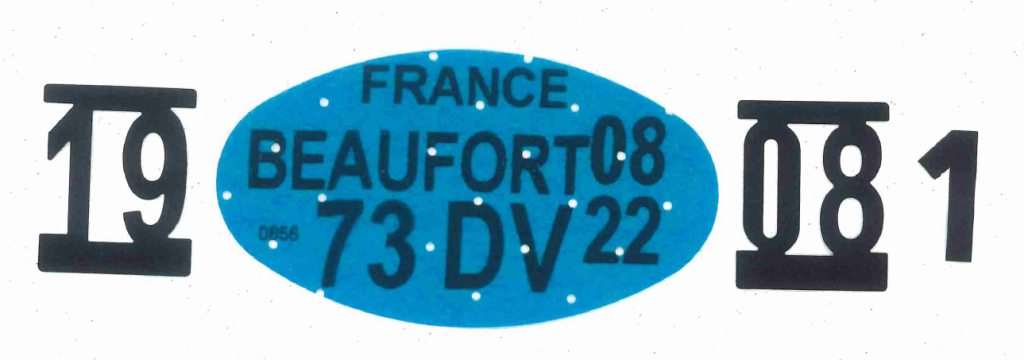
ANSWERS:
- Cheese name: Beaufort
- Department: 73 = Savoie
- Country: France
- Cheesemaking workshop: DV for the Haute-Maurienne Vanoise Dairy Cooperative
- Date of birth: month + day + year. For example, ‘08’ = August, ‘19’ = day, and ‘22’ = 2022.
- Tank number: 1 in this example. Note that, here at the HMV co-op’, we can fill in up to 6 tanks per day)
As for the Bleu de Bonneval sur Arc cheese: what about the maturing aging process?
As the days go by, each piece of Bleu is salted by hand and pierced, before being placed in a temperate cellar. During this time they’re regularly flipped & rubbed for about 20 days. Mould (penicilium) develops itself.
Then comes the sealing stage: wrapping each Bleu de Bonneval sur Arc in aluminium foil (one that is specially designed for being in contact with cheese). Air-deprived, penicillium’s growth slows down (air being one of the necessary conditions for its development).
Blue cheeses are then placed in very cool cellars. Slow maturation begins (60 days).
Time for aromas & creaminess to develop.
Quick summary of the environment
Total capacity of our maturing cellars: 6,300 wheels
Wheels placed on wooden spruce shelves
Cellar temperature: between 8 and 10°C
Cellar humidity: 90%
Minimum maturation time for a Beaufort cheese wheel: 5 months minimum
Could you find out why are we using salt in cheese ripening?
3 purposes:
- Crust formation
- Preservation
- Flavour development